
1928
National attention

With the dust settled on the Federal Parliament’s move to Canberra, 1928 brought unprecedented attention to the Canberra Australian National Football League (CANFL).
The Western Australian senior team made a major detour from its trip to Melbourne and Adelaide to play Canberra in July, with the Prime Minister and Premier of Western Australia publicly exchanging messages of goodwill to mark the occasion. The Victorian schoolboys visited in September, on their way back from the national carnival in Brisbane.
In early May, the Australian National Football Council and senior leagues around Australia sent their greetings and best wishes for the upcoming season.1 The Chairman of the South Australian Football League, T.S O’Halloran KC, and John Curtin, ‘a prominent member of the Westralian League’ and future Prime Minister, visited in May, following a visit by St Kilda Vice-President, Dr Lee Atkinson, the previous month.2 St Kilda later donated six footballs to the CANFL for used during the finals.3 It also donated two footballs to Ainslie and a tricolour flag.4 Collingwood sent two footballs to its Magpie counterparts at Acton.5
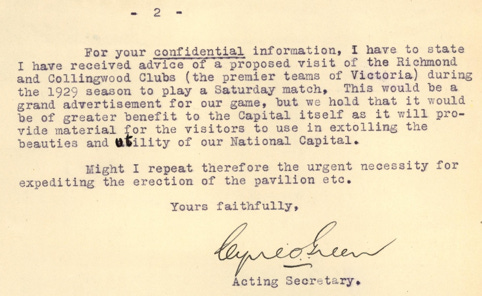
Federal parliamentarians took an interest in the local competition, with one even raising a question in Parliament. Senator George Pearce, in the absence of the Prime Minister, Mr Bruce, opened the season in May, unfurling Acton’s 1927 premiership pennant. In his speech, he promised to consider, as the Minister responsible for the proposed 1931 Empire Exhibition in Sydney, to consider the suggestion that a football stadium should be built and that the two best teams in Australia should play a match. He hoped (somewhat optimistically) that one of the teams would be from Canberra.6
Sir Robert Garran, Commonwealth Solicitor-General and new Canberra resident, agreed to preside over the Tribunal.7 The new Capitol Theatre in Manuka screened Victorian football results on Saturday night.8 For the first time, Melbourne newspapers regularly provided matches reports on CANFL games.9
John Mulrooney, a newly arrived public servant from Melbourne (and Ainslie Football Club delegate) took over as CANFL president from Percy Douglas, who did not seek re-election.10

A five-team competition was restored and extended to 12 rounds, although there were questions about whether the arrival of public servants from Melbourne had actually improved the standard of play. Rugby league officials certainly thought the CANFL was getting ahead of itself.
In an important move for the future of the game, a schoolboys’ competition was established.
The CANFL also began publishing a weekly booklet, ‘similar to, but on a much smaller scale, to the Victorian League Football Record’. On sale for one penny and somewhat grandly titled ‘The National Record’, it attracted criticism at times for its parochial character.11 While eventually costing the League 40 pounds, the League concluded it was a ‘splendid investment’ in ‘propaganda’.12
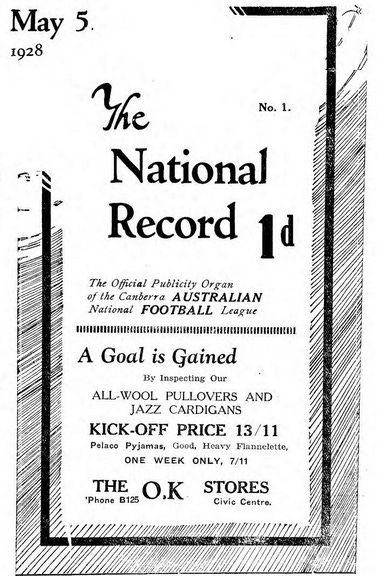
That the 1928 season represented a major step forward for local football was exemplified by the fact that the CANFL’s combined receipts and expenditure were double that of 1927 and in excess of the total for all previous seasons combined.13
Comings and goings
The CANFL had hoped that the influx of public servants from Melbourne would see eight teams playing in 1928 - this didn’t happen.14
Federals had disbanded immediately after losing the first semi-final in 1927.
By early 1928, the Manuka shopping precinct and surrounding residential district were growing quickly,15 making it the logical location for another team. J.H. Tootell (at his fourth club in five seasons) convened a meeting at the new Capitol Theatre on 21 March for the purposes of establishing a new club. At the meeting, chaired by League president, John Mulrooney, Jerry Dillon initially proposed that the new club simply continue on as his old club, Federals. However, Tootell, ‘in view of the fact that district football would soon be necessary in the Territory’, proposed that the name ‘Manuka’ be adopted, playing in Federal’s red and black colours.16 Tootell was probably aware that cricket was, at that time, seriously considering a district structure.17 He might also have thought that calling the club ‘Manuka’ - rather than, for example, after one of the newly minted suburbs of Forrest or Griffith - had the advantage of tying the club to Canberra’s best oval (or maybe the new suburb names simply hadn’t taken hold just yet).18
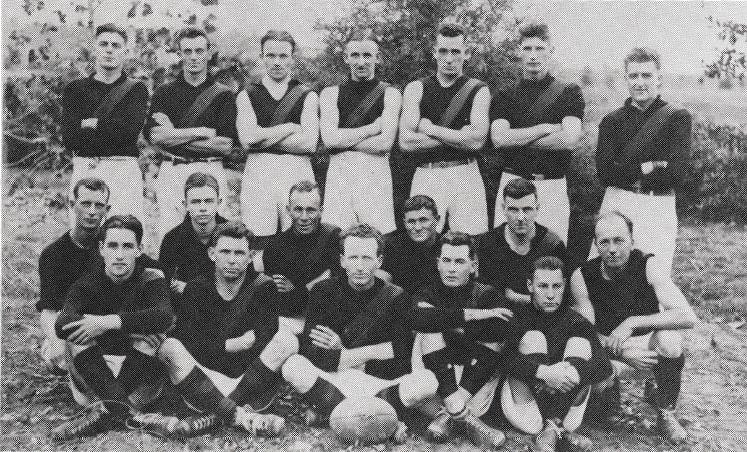
Across the border, Jock Tantau was the ‘moving spirit’ behind a push to revive the Queanbeyan club.19 Thirty people attended a meeting on 9 March at the Commercial Hotel,20 at which it was decided to establish a team. The club’s entry into the league was confirmed at a meeting on 29 March, attended by League officials. While initially intending to adopt Carlton colours, it switched to Melbourne colours, before settling on blue guernseys with red collars and cuffs.21 Queanbeyan’s original 1926 benefactor, W.H. Mason, was bankrupt after a hotel building contract went awry.22
Believing that Australian football was the ‘natural sport’ for ‘boys who have come from the four states playing the Australian game’, the League asked the Royal Military College to enter a side. This request was, however, rebuffed by the Commandant, Colonel Heritage, on the grounds that the College had already organised rugby matches against the ‘greater public schools of New South Wales’.23
Sporting ‘bigotry’ alleged
Relations with the local rugby league - inevitably somewhat precarious, given both aspired to be the dominant code in Canberra - were rocky in 1928.
At a practical level, football code rivalry centred on access to the two main grounds - Manuka and Northbourne - both of which were slated for major improvements (see 1927). Australian football had high-level support - in late March, the Labor member for Maribynong (Victoria), James Fenton, led a CANFL delegation to meet with the head of the Federal Capital Commission, Sir John Butters, to put the case for the Australian game.24
The meeting led to controversy. In what appears to be a Canberra Times editorial, it was alleged that CANFL representatives had made:
utterances… savoured of a bigotry which is quite new to most people, and which is very definitely as unsavoury, as unwelcome and unnecessary as bigotry in other forms has ever been… The number of supporters is no criterion to the excellence of the sport… there is no room for conflict, particularly in Canberra. If there are not enough grounds to go around between the two football codes, the matter may be settled only by an amicable arrangement…25
And, indeed, it appears the CANFL representatives may have been less than magnanimous in their meeting with Sir John. Reportedly, they argued that Australian football was ‘paramount’ in Canberra, that ‘the Rugby game… was purely a B grade combination’ compared with the CANFL, which was a constituent member of the Australian National Football Council, on par with Victoria and the other states. Further, ‘B grade combinations must be prepared to play on grounds which would not be required by the senior grade’.26
To be fair though, the Canberra Times sometimes referred to the Canberra rugby league as the ‘B grade’ competition, with ‘A grade’ referring to inter-district games between the leading Canberra side, Federal Rovers, and teams from Queanbeyan and other towns in the district. Rugby league was also much more severely affected by the changes in local workforce, with the Canberra competition finishing the 1928 season with only three teams (after two disbanded) and A-grade sides in Queanbeyan forced to merge.27 In early 1929, the CANFL said that their critic had since conceded that its claims about the relative status of the two football codes were accurate.28
Adding fuel to the fire, Percy McNamara, Ainslie secretary (and its inaugural President in 1927), had just been elected President of the Canberra-Queanbeyan District Rugby League. This is not as surprising as it may seem, as McNamara was one of the founders of the Canberra (later Ainslie) rugby league club in 1926.29 Nevertheless, the Queanbeyan Age commented that:

Predictably, despite resigning as Ainslie secretary,30 Mr McNamara did not last long in his new position, resigning within weeks. Rugby League vice-president, W.T. Webb was reported as saying that Mr McNamara’s election ‘had created a deplorable state of affairs’, was a ‘flagrant breach of the District League constitution’, and that Mr McNamara’s ‘actions and words… belied his sincerity to rugby’. A letter from Mr McNamara, as Ainslie secretary, to the St Kilda Football Club was held up as proof, the letter referring to ‘the National Game for the National City, which will predominate over all codes in Canberra’. Webb later alleged that McNamara’s election ‘had been a wire-pulling scheme’ and suggested that McNamara had acted dishonourably in not telling the CANFL of his intentions.31
The grounds issue still had not been resolved by mid-April when the CANFL decided that it would, if needed, meet with the Rugby League to resolve the matter.32 A ‘grounds conference’ was soon held which managed to resolve the matter, enabling the CANFL’s 1928 fixture to be released a few days’ later.33
Remarkably, the issue was raised during Question Time in Federal Parliament on 29 May by Frank Anstey, Labor member for Bourke (Victoria). The Minister for Home and Territories, Sir Neville Howse, said in response that:
… to meet existing requirements, temporary arrangements are -being made by which certain football bodies, viz., the Federal Capital Territory District Rugby League, and the Canberra Australian National Rules Football League, will have the right to use the grounds during the present season on particular dates that have been mutually agreed upon between the interested bodies. A nominal rental of £5 is being charged, under these conditions, for each of the Manuka and Northbourne ovals, no charge being proposed for Kingston and Acton grounds.34
In early July, the Federal Capital Commission wrote to the CANFL and the Rugby League informing them that a new arrangement would apply - the CANFL would have Northbourne Oval, and the Rugby League would have Manuka Oval, for the remainder of the season. Initially, the CANFL protested vehemently about this change, to which it claimed it had not assented. Not surprisingly, Manuka Football Club was concerned at the possible loss of its home ground.35 However, tempers appear to have cooled, with the 21 July edition of the CANFL’s National Record pointing out that:
The present leases, however, are only a temporary expedient, and while they may not suite the peculiar temperaments of Australian football enthusiasts, they at least assure the League of having grounds available for the competition fixtures. At the Grounds Conference with the Rugby League at the beginning of the season, there was also a mutual agreement by which the code in possession would surrender a ground required by the other code for a game with an interstate or holidaying team.36
As it turned out, Manuka played two games at its ‘home’ ground in August, presumably with the consent of the Rugby League. The Federal Capital Commission’s annual report drily noted that the resolution of the grounds issue was ‘somewhat involved’.37

The season
A five-team competition returned, with a weekly bye. Teams played home games in their home suburb.38 In particular, Eastlake played home games at Kingston for the first time. The local cricket club had first played there in 1927-28 and had built a small pavilion which Eastlake was able to use (to the cricketers’ chagrin).39 The oval itself was 155 metres long and 128 metres wide.40
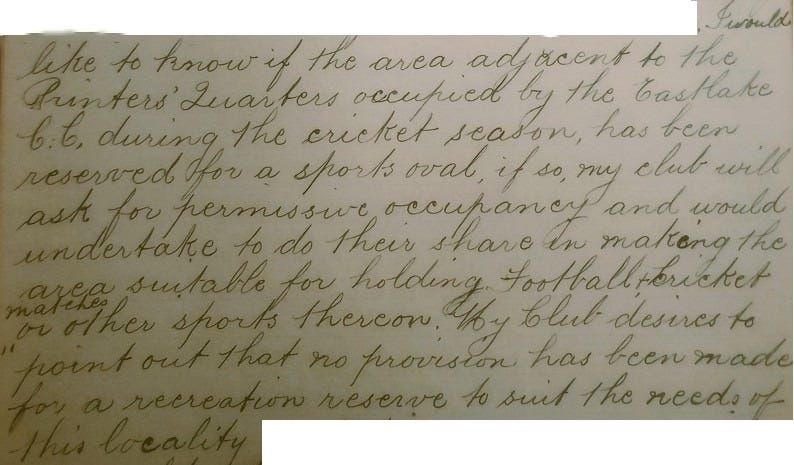
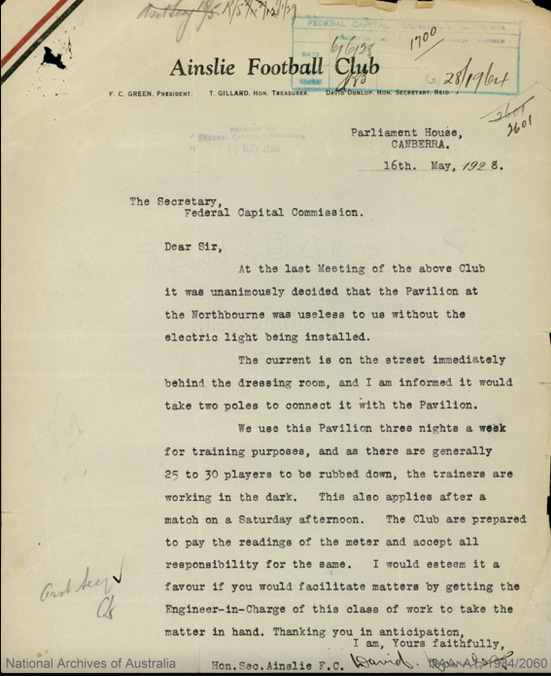
Facilities at football grounds remained spartan. As noted in The League Takes Shape, construction work reduced substantially once the provisional Parliament House was completed in 1927. Construction workers were retrenched and the rough camps in which they lived were disbanded. The Federal Capital Commission then began moving the small wooden ‘cubicles’ in which these workers had lived to football grounds as makeshift dressing sheds.41 They were the only dressing room accommodation at Acton and Manuka, and were used by ‘away’ teams at Northbourne and Kingston (where there were small pavilions for the home teams). More positively, a scoreboard was erected at Northbourne oval.42 Ainslie also requested that electric light be installed in the Northbourne pavilion. While the local authorities appear to have seriously considered the request, it was not implemented - Ainslie had to ask again in May 1930.43
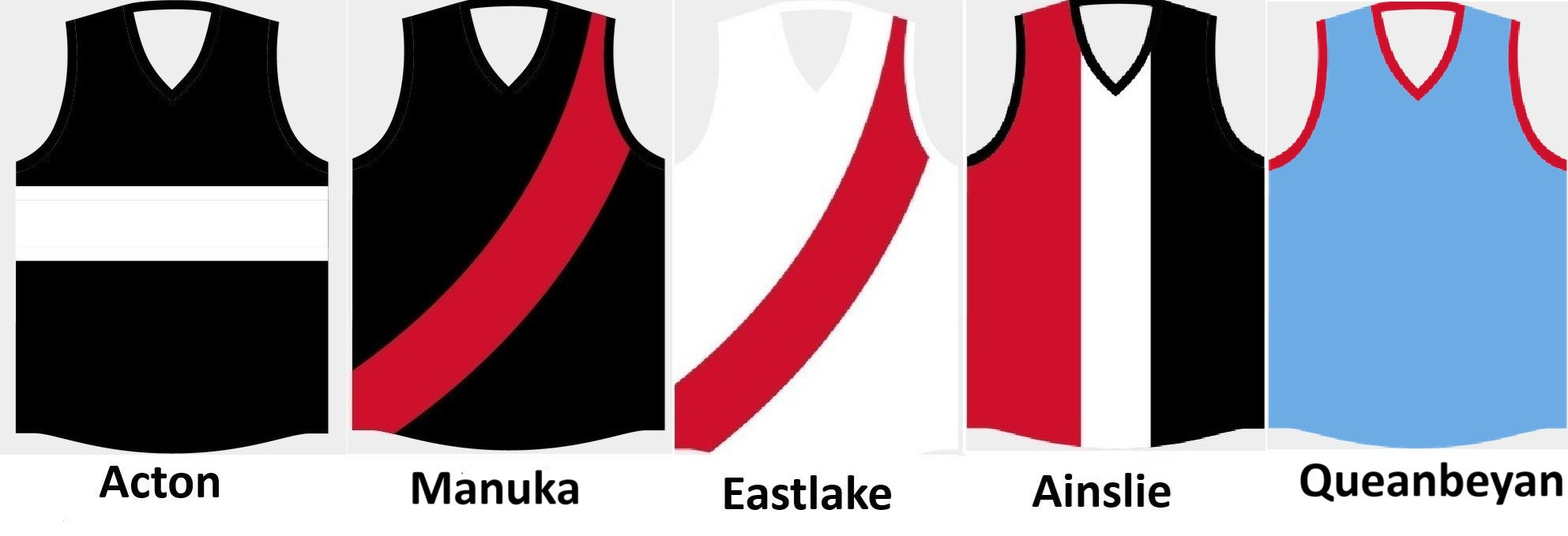
A significant improvement in commitment and organisation was immediately apparent. Teams played a number of practice matches in April.44 Coaches are mentioned for the first time.45

Five umpires were appointed, who seemed to attract less criticism than in previous seasons. And what criticism there was centred on rule changes introduced that year which few players or supporters appeared to understand, and which led to some inconsistencies in umpires’ interpretations.46

Teams were almost unrecognisable from 1927, with only a handful of players from 1927 appearing for the continuing clubs, Eastlake, Ainslie and Acton, at the start of 1928.47 Several players left the district, including some leading players; some retired, possibly anticipating an improved competition that would outreach them; and many players moved clubs. Ex-Federals players spread around the competition and the new clubs, Manuka and Queanbeyan, drew players from existing clubs. There were surprisingly few recruits from Melbourne, the outstanding one being Harry Clapson (Acton), who had played for Norwood in South Australia and for North Melbourne in its first season in the Victorian Football League.48 Ainslie reportedly included 12 Tasmanians in its opening round match against Manuka.49

This meant that the 1928 season, while an improvement on the disappointing season the year before, did not see a major step-up in playing standards (Jerry Dillon even claimed that the standard was the worst ever50). It was, however, a more balanced competition with Eastlake, Ainslie and Queanbeyan evenly matched.
Acton was badly hit by the player movements outlined above and were also hard-hit by injuries throughout the season, so much so that they forfeited a match in August with 13 players out. Half its team was aged under 21 in the latter part of the season. While Acton’s form was therefore inconsistent over the season, it did manage wins over Ainslie and Eastlake and went close against Queanbeyan.51

Similarly, Manuka were young and inexperienced overall, and suffered with injuries. The highlights were its two wins over Acton, although it finished with an 135 point loss to Eastlake in the last round.52
Matches on 12 May were marred by torrential rain and strong winds, so much so that:
the latter phases were almost farcical, when players not close to the play sheltered behind cars along the boundary. To add to their discomfort, the players were crowded into small cubicles, in which they had to dress and be rubbed down.53
Midway through the season, there were no undefeated sides, with Eastlake the most consistent, only losing one game, to Ainslie by 3 points (when it kicked 5.17):54

This pattern continued through the latter part of the season, with the final four settled before the last round was played. A minor controversy arose late in the season about the use, by Eastlake fullback, George Orford, of the place-kick when kicking out against the wind after a behind had been scored. The CANFL clarified that this practice was consistent with the rule requiring that the ‘ball shall be kicked clear from hand and foot’.55
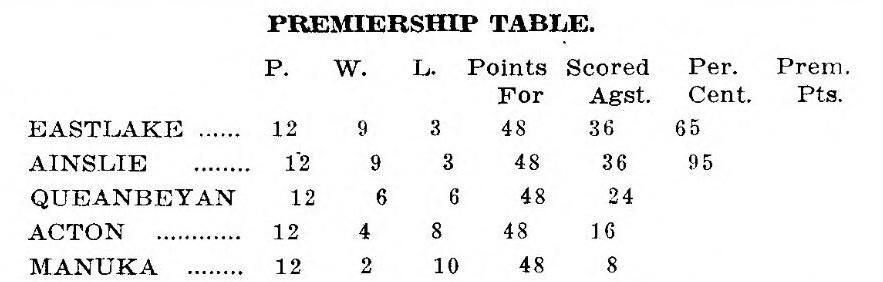
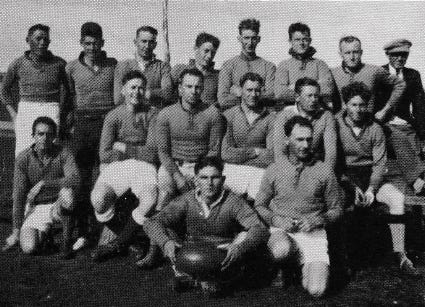
Underscoring the evenness of the competition, Queanbeyan defeated Eastlake in first semi final, Ainslie defeated Queanbeyan in the final, then Eastlake defeated Ainslie in the Grand Final by 40 points at Northbourne Oval. The ‘red and whites’ were five goals up at quarter time playing with a strong wind at their back, which then abated, becoming gusty for the rest of the match. Still, Eastlake were agreed to be the better team on the day.56 Thompson (kneeling right in photo below) umpired.57
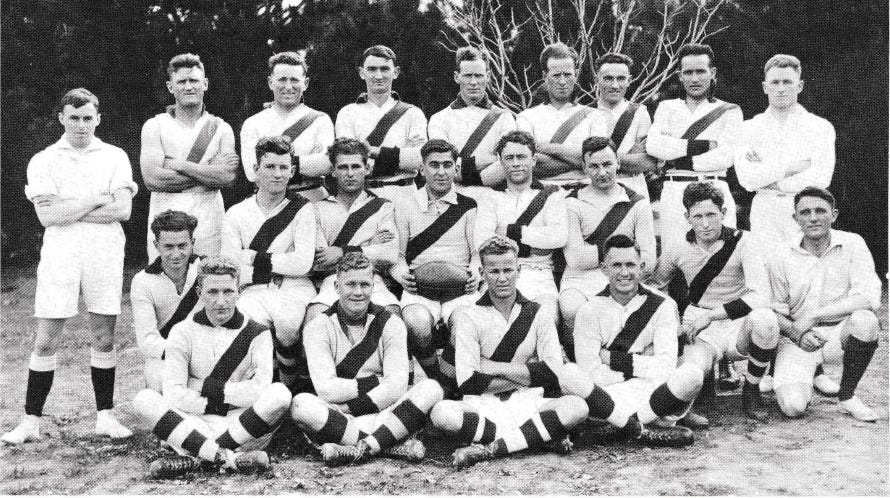
Ainslie had earlier defeated Acton in the second semi-final, perhaps spurred on by offer of a Stetson hat to best player (won by J Griffiths).58
Sir Robert Garran had generally had a fairly quiet season at the disciplinary tribunal until the Ainslie-Queanbeyan final when an ugly brawl broke out in the third quarter, so much so that, at one point, it looked like ‘police assistance’ would be needed to restore order.59 Smith (Queanbeyan) was charged with using threatening language and disputing the umpire’s decision - Garran gave him six weeks! W. Griffiths (Ainslie) got two weeks for striking Smith, and so missed the grand final.60

Western Australia visits the capital
At various times during the season, hopes rose that the Victorian state team, or a VFL side, or even a side from South Australia or Tasmania, might visit.61 Ultimately though, it was the Western Australian state team that accepted the CANFL’s invitation to come to Canberra.62
Most likely this happened because, at the time, the President of the Western Australian Football League, Alfred Moffat, was also the President of the Australian National Football Council. He sent a message to CANFL President, John Mulrooney, saying that ‘your body can rely upon Western Australia by practical actions assisting to advance the national game in the Commonwealth to the position of pre-eminence to which it is entitled’.63
The Labor Premier of Western Australia, Philip Collier, and the conservative Prime Minister, Stanley Bruce, also publicly exchanged messages in the lead-up to the game.64

The messages implicitly concede that some ‘tightening of the bonds of fellowship’ and ‘cementing of harmonious relations’ were in order. Only five years later, Western Australians would vote to secede from the Commonwealth.65
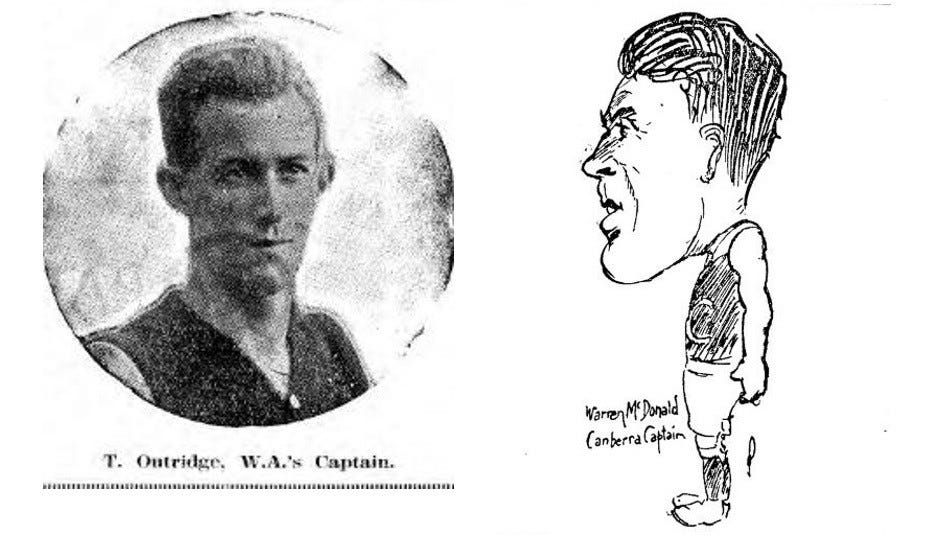
The trip to Canberra was no minor thing for the Western Australian players, as it added substantially to an already long train trip for the team, who were also playing Victoria and South Australia. Indeed, upon their return to Perth, their captain, Tom Outridge, lamented the amount of train travel undertaken in a short period of time.66
No fewer than 80 players and supporters left Perth to cross the Nullabor Plain.67 They first travelled to Melbourne, where the team was outclassed by Victoria on Saturday, 21 July. Losing by 65 points, one commentator described the side as the ‘weakest team I have seen fielded by West Australia’.68 Indeed, it was generally observed that the Western Australians were young, possibly ‘the youngest team that has ever done battle’ for the state, with an average age of 24 years.6970 Only 22 players were included in the squad, for three games in a week.71
That said, the team that arrived in Canberra on the following Tuesday was led by one of the best ruckmen in Australia, Tom Outridge, and included several future Western Australian Hall of Fame inductees.72
After yet another uninspiring ‘possibles versus probables’ game,73 a Canberra team was selected that contained only three players from the previous year’s loss to Queensland, one of whom was appointed captain, Warren McDonald. The locals were also physically shorter and lighter than their opponents, with an average height of around 172 cm as against 177, and an average weight of around 73 kilograms as against 76.747576
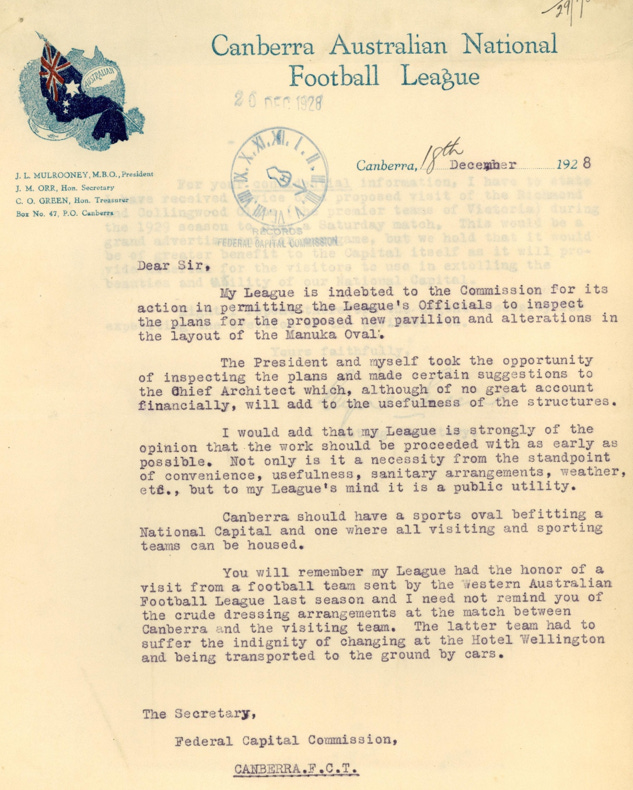
The state of Manuka Oval was a problem. A CANFL report to the local authorities concluded that the ground was ‘unsuited for a first-class exhibition of our national game…’, being ‘excessively hard, and owing to the tussocky nature of the grass is very uneven’. The boundary and ‘goal kicking off spaces’ and centre circle were ‘very poorly defined’, and the facilities for players and the public were ‘of the most primitive description’. The report proposed to ‘allow sheep to graze on the ground’ and that it be watered and rolled. It seems nothing was done about the playing surface as remedial treatment of ground would, at least in the short term, ‘affect to a great extent the grass surface’.77 The ‘crude dressing room arrangements’ at Manuka meant the Western Australians had to change at the Hotel Wellington, where they were staying, and be driven to the oval.78
The young visitors also caused some mischief involving Telopea Park School students:

The match began at 3pm on Wednesday afternoon, 25 July, before 500 spectators. It was predictably one-sided, with the Western Australians winning by 73 points.79 To avoid a colour clash - both sides usually wore green - Canberra wore Ainslie colours. Madame Wardrope’s Tea Rooms in Manuka supplied beef tea at half-time.80 The Western Australians departed for Adelaide on the 8.20pm train that night.81
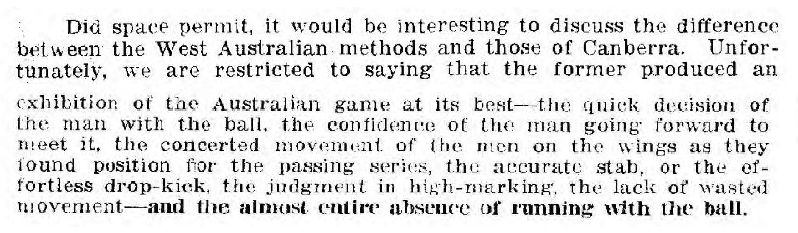
The Western Australian captain, Tom Outridge, would later say that:

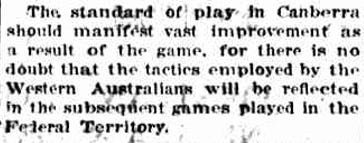
For the locals, the Canberra Times commented that:
In September, noting that the Territory did not have official sporting colours, and with the clash with the Western Australians firmly in mind, it was mooted that Canberra should adopt the Commonwealth’s colours of blue and gold.82
Schoolboys take the field
Work to establish a schoolboys’ competition began at the outset of the season.83 Telopea Park School (primary and secondary) was first to form a team, soon followed by St Christopher’s Primary School. Ainslie Primary would be the third and final school to join the competition, while other schools such as Duntroon and Molonglo played rugby league.8485 The CANFL donated guernseys, appointed coaches and provided footballs.86 Teachers at the schools were committed although none had ‘a working knowledge of the National game’, not surprising given they were employed by the New South Wales Education Department.87 J.T Tootell donated a pennant for the winner of the competition.88
The first recorded match was an intra-school game between Telopea Park teams on 9 May.89 Around the same time, Eastlake formed a second eighteen comprising schoolboys and ‘those in the early stages of employment’ (many apparently at the Government Printing Office).90 On 2 June, Telopea and Eastlake played the first official juniors match in Canberra.

Telopea won by 22 points, although Eastlake exacted revenge in a return match a few weeks later, winning by a point. The matches were featured in the weekly National Record, which included team lists and match reports.91 Telopea Park captain, Bob Knights, was an immediate star, and would make his debut for Eastlake seniors later in the season.92
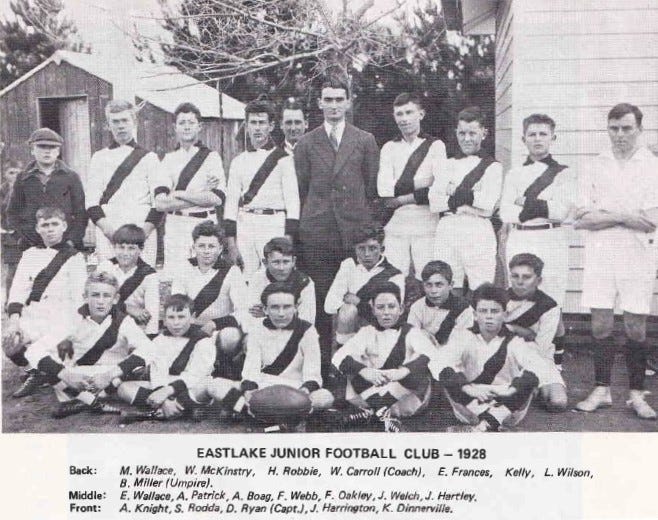
More scratch matches were played through July93 before a six-round, four-team competition began in early August.94 Matches were played on Friday afternoon between Telopea Park A and B sides, Ainslie, and St Christopher’s. The competition age limit was 14 years, a year below the ‘Australian standard’, so as to ‘place teams on more or less even terms’. Telopea Park A won the premiership, with St Christopher’s runner-up.95 Ken Dinnerville was awarded the medal (donated by Jerry Dillon) for best player in the competition.96
On Saturday 18 August, a Canberra juniors side was defeated by a visiting South Sydney Junior Association team by 17 points. The Canberra side comprised Telopea Park secondary school players, Eastlake juniors and some younger Manuka players.97
The Victorians visit
In the first week of September, the Victorian schoolboys side visited Canberra for three days on their return journey from Brisbane, where they had just won the national carnival. The trip highlighted Canberra’s newly-found attractiveness as the capital of the nation, with the Victorians receiving an official welcome from Sir John Butters, undertaking a tour of the city, visiting places of education interest (such as Parliament House), before going to the ‘pictures’ at Capitol Theatre on Wednesday evening.98
They found time to play a Canberra schoolboys team on Thursday afternoon at Manuka, the start set for 1pm to enable workers to see the game in their lunch hour. The Canberra team comprised players from Telopea Park secondary school and a player each from Telopea Park, St Christopher’s and Ainslie primary schools. All players had to be 15 years or younger. While the Victorians won, it was only by 34 points, ‘not as pronounced as the majority’ expected. Possibly, the ‘wild west wind’ undermined the ‘systematic play of the dark blue team’. Bob Knights was best for the locals.99
The inaugural schoolboys season finished with a four-day visit by a team from the Junior Technical School, Gardener’s Road, Mascot. Like the Victorians, this trip combined education and football, with the visiting team defeating Telopea Park (who were two players short) by 34 points and a physically much smaller Canberra primary schools side by 81 points.100
Greetings, Canberra Times, 7 May 1928, p.1; National Record, 19 May 1928, p.2. Trove - National Library of Australia, accessed 20 December 2024.
Football Officials, Canberra Times, 17 May 1928, p.5; St Kilda Official, Canberra Times, 17 April 1928, p.2. Trove - National Library of Australia, accessed 21 December 2024.
Reserve Grade, Canberra Times, 31 August 1928, p.5. Trove - National Library of Australia, accessed 20 December 2024.
Ainslie Football Club, Canberra Times, 17 February 1928, p.8; National Rules, Canberra Times, 18 April 1928, p.5. Trove - National Library of Australia, accessed 20 December 2024.
Acton Football Club, Canberra Times, 25 February 1928, p.2; Club notes, Canberra Times, 12 May 1928, p.2. Trove - National Library of Australia, accessed 20 December 2024.
Canberra’s season opened, Sun News-Pictorial (Melbourne), 7 May 1928, p.30. The Empire Exhibition did not proceed for cost reasons: Empire Exhibition Bill to be dropped, Herald (Melbourne), 1 June 1928, p.3. Trove - National Library of Australia, accessed 29 March 2026.
National Rules, Canberra Times, 24 March 1928, p.2; National Rules, Canberra Times, 5 April 1928, p.5. Trove - National Library of Australia, accessed 21 December 2024.
National Record, 12 May 1928, p.5. Trove - National Library of Australia, accessed 21 December 2024. The Canberra Times also reported Victorian Football League and Victorian Football Association scores each week.
See, for example: In other states, Age (Melbourne), 11 June 1928, p.9; Canberra football, Sporting Globe (Melbourne), 7 July 1928, p.3. Trove - National Library of Australia, accessed 29 March 2026.
National Rules League, Canberra Times, 3 March 1928, p.2. Trove - National Library of Australia, accessed 29 March 2026.
The National Record was edited by John O’Sullivan: Club Notes, Canberra Times, 12 May 1928, p.2. For criticism of the Record, see: Readers’ Views, Canberra Times, 11 June 1928, p.2; National Football Publicity, Canberra Times, 26 June 1928, p.2. O’Sullivan, ‘objecting to dictation in his editorial duties’, actually tendered his resignation to the League in June 1928, which it declined to accept: Local Team, Canberra Times, 28 June 1928, p.2. Trove - National Library of Australia, accessed 21 December 2024.
National Rules, Canberra Times, 26 March 1929, p.3. Trove - National Library of Australia, accessed 3 January 2024.
Australian Rules, Canberra Times, 26 September 1928, p.5. Trove - National Library of Australia, accessed 20 December 2024. The League also received a ‘substantial’ donation from Syd Sherrin, the football manufacturer, and the Western Australian state side agreed to forgo a thirty pound payment due to it from the CANFL: National Rules, Canberra Times, 26 March 1929, p.3; Australian Rules, Canberra Times, 26 September 1928, p.5 Trove - National Library of Australia, accessed 3 January 2024.
Minutes of ANFC meeting, August 1927, p.10 (MCC Library).
Manuka, Canberra Times, 6 December 1927, p.1 Trove - National Library of Australia - accessed 15 December 2024.
New Club, Canberra Times, 22 March 1928, p.5. Trove - National Library of Australia - accessed 15 December 2024. See also: Proposed club, Canberra Times, 19 March 1928, p.1; and National Football, Canberra Times, 13 March 1928, p.5.
The Canberra Times reported on 14 March 1928 (p.5.) that the Federal Capital Cricket Association was giving serious consideration to the ‘introduction of district cricket in distinction to the present system of club competitions’. On 30 July 1928, the Association adopted a six-club district structure: Cricket, Canberra Times, 31 July 1928, p.1.
Many Canberra suburbs were renamed in early 1928. Manuka and South Blandfordia became Griffith; Blandfordia became Forrest; Eastlake and Causeway became Kingston; Ainslie became Braddon; South Ainslie became Reid and North Ainslie became Ainslie: The Suburbs, Canberra Times, 16 December 1927, p.1; Trove - National Library of Australia, accessed 15 December 2024. Red Hill was to become ‘Mugga’ but it appears this never took hold.
Football, Canberra Times, 7 March 1928, p.5. Trove - National Library of Australia, accessed 15 December 2024.
Cecil Tantau - presumably a close relation of Jock’s - was the proprietor of the Commercial Hotel: Publican’s appeal fails, Queanbeyan Age, 16 February 1928, p.2. Trove - National Library of Australia, accessed 15 December 2024.
Australian Rules Football, Queanbeyan Age, 13 March 1928, p.1; Football, Canberra Times, 23 March 1928, p.5. Australian Rules Football, Canberra Times, 30 March 1928, p.1; Queanbeyan Club Formed, Canberra Times, 31 March 1928, p.3. Trove - National Library of Australia, accessed 15 December 2024. Curiously, the Canberra Times referred to Queanbeyan as the ‘blue and whites’ early in the 1928 season: National Rules, Canberra Times, 12 May 1928, p.2.
Bankrupt, Canberra Times, 4 April 1928, p.4; Builder’s losses, Canberra Times, 29 August 1928, p.1. Trove - National Library of Australia, accessed 15 December 2024.
National Rules, Canberra Times, 24 March 1928, p.2; National Rules, Canberra Times, 5 April 1928, p.5. Trove - National Library of Australia, accessed 15 December 2024.
National Rules, Canberra Times, 24 March 1928, p.2; National Record, 12 May 1928, p.7. Trove - National Library of Australia, accessed 21 December 2024.
Bigotry in Sport, Canberra Times, 2 April 1928, p.2. Trove - National Library of Australia, accessed 21 December 2024.
National Rules, Canberra Times, 5 April 1928, p.5. Trove - National Library of Australia, accessed 21 December 2024.
Rugby, Canberra Times, 10 March 1928, p.2. Rugby League, Canberra Times, 31 March 1928, p.3; Sport in Canberra, Canberra Times, 1 January 1929, p.2; Rugby League, Canberra Times, 21 April 1928, p.3; West Queanbeyan amalgamated with the Waratahs club: Tully Cup, Canberra Times, 18 May 1928, p.5; Queanbeyan Koalas initially disbanded but then merged with the Queanbeyan Warrigals and the ‘All-Reds’: Koalas Withdraw, Canberra Times, 17 May 1928, p.5; Competition Play, Canberra Times, 19 May 1928, p.2; Club amalgamations, Canberra Times, 23 June 1928, p.2. Trove - National Library of Australia, accessed 21 December 2024.
National Rules, Canberra Times, 26 March 1929, p.3. Trove - National Library of Australia, accessed 3 January 2024.
Transfer to Rugby, Canberra Times, 24 March 1928, p.2. Trove - National Library of Australia, accessed 15 December 2024.
Rugby League, Canberra Times, 31 March 1928, p.5. Trove - National Library of Australia, accessed 21 December 2024.
Rugby football, Queanbeyan Age, 27 March 1928, p.2; Rugby stir, Canberra Times, 16 April 1928, p.3; Rugby stir, Canberra Times, 6 June 1928, p.1. Trove - National Library of Australia, accessed 15 December 2024.
Conference, Canberra Times, 13 April 1928, p.2. Trove - National Library of Australia, accessed 21 December 2024.
National Rules, Canberra Times, 17 April 1928, p.5; National Record, 21 July 1928, p.2: Trove - National Library of Australia, accessed 21 December 2024.
Hansard, House of Representatives, 29 May 1928, p.5275; Sports Ovals, Canberra Times, 30 May 1928, p.4. Trove - National Library of Australia, accessed 21 December 2024.
Sports Grounds, Canberra Times, 11 July 1928, p.4; Sports Grounds, Canberra Times, 12 July 1928, p.4. Sports Grounds, Canberra Times, 20 July 1928, p.4. Trove - National Library of Australia, accessed 21 December 2024.
National Record, 21 July 1928, p.2. Trove - National Library of Australia, accessed 21 December 2024.
1927-28 Annual Report, Federal Capital Commission, p.23. Trove - National Library of Australia, accessed 21 December 2024.
Eastlake played at a ground opposite the Printers’ Quarters in Eastlake. The Printers’ Quarters were located diagonally across from present-day Kingston Oval, on Dawes and Leichhardt Street (Gugler (1994), p.312). Queanbeyan again played at Queanbeyan Showgrounds. Acton played home games at Acton Sports Ground; Manuka played at Manuka, and Ainslie played at Northbourne.
Letter from A Wright to Secretary, FCC, 29 July 1929; undated FCC memo, Sports Grounds, work completed and outstanding: NAA, A659, 1944/1/3425.
Letter from Secretary, FCC, to CANFL, 9 May 1929: NAA, A659, 1944/1/3425.
Federal Capital Commission, Main requisition form, 28 April 1928: NAA, A1, 1937/1077. Undated 1928 memorandum from Social Service Officer to Industrial Officer: NAA, CP698/9, 45/5. Letter from CANFL to FCC, 28 May 1929: NAA, A1, 1934/2060. FCC Job Sheet, 17 May 1929: NAA, A659, 1944/1/3425.
National Rules, Canberra Times, 18 April 1928, p.5; National Rules, Canberra Times, 19 April 1928, p.5. Trove - National Library of Australia, accessed 20 December 2024.
Letter from Assistant Secretary, Ainslie Football Club to Department of Works, 10 May 1930: NAA, A1, 1934/2060.
See, for example: National Rules, Canberra Times, 2 April 1928, p.3; National Rules, Canberra Times, 21 April 1928, p.5; National Rules, Canberra Times, 28 April 1928, p.1. Trove - National Library of Australia, accessed 20 December 2024.
The known coaches were: Wallie Smallhorn (Manuka), who had played four games for South Melbourne in 1905-06; G. Turnbull (Eastlake); Harry Clapson (Acton) and George Welsh (Ainslie). It is not known if Queanbeyan formally had a coach: Miller (2013), p.12; National Rules, Canberra Times, 14 April 1928, p.3; Australian Rules, Canberra Times, 22 September 1928, p.5; National Record, 5 May 1928, p.6; National Record, 8 September 1928, p.5. Trove - National Library of Australia, accessed 19 December 2024.
The five umpires were: W. Buchanan, J.B. Duggan, R.W Miller, R. Thompson and C Williams: Club Notes, Canberra Times, 12 May 1928, p.2. In August however, Williams and Duggan returned to playing, with Eastlake and Manuka respectively: National Record, 11 August 1928, p.3. Clubs supplied boundary and goal umpires: National Rules, Canberra Times, 18 April 1928, p.5. Rule changes were introduced by the Australian National Football Council: National Football, Canberra Times, 26 April 1928, p.2; National Rules, Canberra Times, 29 May 1928, p.3; National Record, 4 August 1928, p.2. Trove - National Library of Australia, accessed 20 December 2024.
The North Melbourne website mistakenly states that Harry Clapton returned to Melbourne in mid-1928 to play with Williamstown. It confuses Harry Clapton with A J Clapson (possibly a brother), who transferred from North Melbourne to Williamstown in mid-1928: see Permits for Yarraville players, Sun News Pictorial, 7 June 1928, p.35. Former Federals players who moved to new clubs included: the Ryan brothers (Eastlake); Burr (Ainslie); Sydes and Prendergast (Queanbeyan); Brown and Dencio (Manuka). Retirees included Acton players, Hall and O’Neill. Acton also lost Bastow (Ainslie), Tudor (Queanbeyan), the Lindley brothers (Manuka) and Morecombe (Eastlake). Ainslie lost Richards, P Tantau, Thomas and Wills to Queanbeyan, as well as leading player, Allan Fraser (destination unknown). Players who left Canberra include: Phelan, Redman, Peverill, Probyn (all Acton); McDowell (Ainslie); Hawkes, Delaney, Pointon and leading player, Fred Ekman (all Eastlake). Ekman moved to Stawell. Incoming players from Victoria included: Torbett (Eastlake), Clapson and Mackenzie (Acton), Easson and Tomsitt (Ainslie) and Moroney (Manuka): National Record, 5 May ,12 May, 9 June and 14 July 1928; National Rules, Canberra Times, 18 April 1928, p.5. Trove - National Library of Australia, accessed 20 December 2024.
The Mainland - Day by Day, Mercury (Hobart), 12 May 1928, p.8. Trove - National Library of Australia, accessed 29 March 2026.
Challenge, Canberra Times, 23 June 1928, p.2. Trove - National Library of Australia, accessed 20 December 2024.
Reserve Grade, Canberra Times, 31 August 1928, p.5; Club Jottings, Canberra Times, 18 August 1928, p.2; National Record, 28 July 1928, p.6. Trove - National Library of Australia, accessed 20 December 2024.
National Record, 14 July 1928, p.7; Club Notes, Canberra Times, 21 July 1928, p.6; Australian Rules, Canberra Times, 28 July 1928, p.6; National Record, 4 August 1928, p.7; Club Jottings, The Canberra Times, 25 August 1928, p.6; Australian Rules, Canberra Times, 27 August 1928, p.3. Trove - National Library of Australia, accessed 21 December 2024.
Football Notes, Canberra Times, 19 May 1928, p.2. Trove - National Library of Australia, accessed 21 December 2024.
Ainslie’s win, Canberra Times, 21 May 1928, p.3. Trove - National Library of Australia, accessed 21 December 2024.
National Record, 18 August 1928, p.6; 1 and 6 September 1928, p.6: Trove - National Library of Australia, accessed 16 April 2026.
Ainslie outclassed in Grand Final, Canberra Times, 24 September 1928, p.3. Trove - National Library of Australia, accessed 21 December 2024.
Australian Rules, Canberra Times, 22 September 1924, p.5. Trove - National Library of Australia, accessed 21 December 2024. Umpire Miller is standing on the left. Usually a field umpire, possibly he was appointed boundary umpire for the day. F Himming is standing at the back right - possibly he was Eastlake’s goal umpire: Miller (2013), p.16.
National Record, 8 September 1928, p.6; National Record, 15 September 1928, p.6. Trove - National Library of Australia, accessed 19 December 2024.
Players come to blows, Canberra Times, 17 September 1928, p.3. Trove - National Library of Australia, accessed 21 December 2024.
Disqualified, Canberra Times, 22 September 1928, p.5. Trove - National Library of Australia, accessed 21 December 2024.
National Rules, Canberra Times, 21 April 1928, p.5; National Rules, Canberra Times, 28 April 1928, p.3; National Rules, Canberra Times, 2 May 1928, p.5; National Record, 7 July 1928, p.3; National Rules, Canberra Times, 12 July 1928, p.4. Trove - National Library of Australia, accessed 19 December 2024.
Footballer’s Tour, Daily News (Perth), 24 July 1928, p.1. Trove - National Library of Australia, accessed 19 December 2024.
Dinner to Team, Canberra Times, 26 July 1928, p.1. He also told that press that the press that the aim of the visit was ‘to assist to advance the national game in the Federal Capital’ Generous W.A, Sporting Globe (Melbourne), 6 June 1928, p.8. Trove - National Library of Australia, accessed 19 December 2024.
Dinner to Team, Canberra Times, 26 July 1928, p.1. Trove - National Library of Australia, accessed 19 December 2024.
Western Australians had always been somewhat ambivalent about their about their place in the Australian federation, which they were the last to join at the turn of the century. A secessionist movement had sprung up in the 1920s, but did not gain wide popular support until 1930, in the midst of the Great Depression. Then, in 1933, Western Australians would vote by a margin of two-to-one to secede. Hedging their bets though, they also voted out (in a landslide) the state government which had strongly supported the referendum, electing in its place an anti-secessionist government led by 1928 premier, Philip Collier. Collier did agree to send a delegation to the United Kingdom to press for secession, which failed, and the issue died away by the mid-1930s. Generally, see: Musgrave T., The Western Australian secessionist movement, 2003 Macquarie Law Journal, p.6. Accessed 21 December 2024.
W.A Footballers, Daily News (Perth), 1 August 1928, p.5. Trove - National Library of Australia, accessed 19 December 2024.
Interstate tour, West Australian, 14 July 1928, p.16; State team’s tour, Daily News (Perth), 14 July 1928, p.4. Trove - National Library of Australia, accessed 19 December 2024.
The Western Debacle and Western Australia played a rugged by inefficient game, Sporting Globe (Melbourne), 21 July 1928, p.2. Trove - National Library of Australia, accessed 19 December 2024.
Interstate and club mate, Daily News (Perth), 13 July 1928, p.8; National Record, 25 July 1928, p.2. Trove - National Library of Australia, accessed 19 December 2024.
The side also didn’t include any East Fremantle players, who were on a club tour to Tasmania: State team’s tour, Daily News (Perth), 14 July 1928, p.4. Trove - National Library of Australia, accessed 19 December 2024.
W.A Footballers, Daily News (Perth), 1 August 1928, p.5. Trove - National Library of Australia, accessed 19 December 2024.
National Record, 21 July 1928, p.7. The Players, Canberra Times, 25 July 1928, p.5. Trove - National Library of Australia, accessed 19 December 2024. Western Australian players included Don Marinko (snr) and the high-marking Frank Hopkins, both 19 at the time of the Canberra game, as well as John Guhl, John Leonard and John McDiarmid
National Rules, Canberra Times, 9 July 1928, p.3. There was, in fact, some debate about whether to play a trial match at all, given previous such matches had fared badly: Local team, Canberra Times, 28 June 1928, p.2; National Record, 7 July 1928, p.3; Readers’ views, Canberra Times, 2 July 1928, p.2; although, extraordinarily, one letter sent to the Canberra Times was claimed to be forged: Forged letter, Canberra Times, 3 July 1928, p.1. Trove - National Library of Australia, accessed 19 December 2024.
National Record, 25 July 1928, p.2. Trove - National Library of Australia, accessed 19 December 2024.
Canberra, Canberra Times, 25 July 1928, p.5. Trove - National Library of Australia, accessed 19 December 2024.
National Record, 25 July 1928, p.2.
‘Report on the condition of Manuka Oval’, W G Chapman, G Bryant, D Dillon, July 1928; letter from FCC to CANFL, 19 July 1928: NAA, A1, 1934/394. ‘Main requisition form (cancelled)’, 18 July 1928: A6266, G1930/2127.
Letter from CANFL to the Secretary of the Federal Capital Commission, 18 December 1928: National Archives of Australia, CP698/9, 45/1.
Dinner to Team, Canberra Times, 26 July 1928, pp.1-2. WA Footballers, Sunday Times (Perth), 29 July 1928, p.9. Trove - National Library of Australia, accessed 19 December 2024.
National Record, 14 July 1928, p3; National Record, 25 July 1928, p.5; National Record, 4 August 1928, p.2. Trove - National Library of Australia, accessed 19 December 2024.
West Australian team, Canberra Times, 26 July 1928, p.5; Team Farewelled, Canberra Times, 26 July 1928, p.2. They lost to South Australia by 11 points, after leading for three quarters: Inter-state football, The Advertiser (Adelaide), 30 July 1928, p.18. Trove - National Library of Australia, accessed 19 December 2024.
Canberra’s colours, Canberra Times, 10 September 1928, p.1. Trove - National Library of Australia, accessed 19 December 2024.
National Rules, Canberra Times, 24 March 1928, p.2. Trove - National Library of Australia, accessed 16 December 2024.
Australian Rules, Canberra Times, 22 March 1928, p.5; St Christopher’s Favours National Game, Canberra Times, 20 April 1928, p.5; School match, Canberra Times, 11 August 1928, p.5. Trove - National Library of Australia, accessed 16 December 2024. The Telopea Park team was coached by ‘Mr Jamieson’. Telopea Park also played rugby league: Telopea Park School, Canberra Times, 30 August 1928, p.5.
St Christopher’s had only just opened; Ainslie was six months’ old and Telopea had opened in 1923: City Schools, Canberra Times, 31 January 1928, p.1; https://www.ainslies.act.edu.au/our_school/our_history; https://www.telopea.act.edu.au/about_our_school/history.
National Record, 12 May 1928, p.2; Ainslie Public School, Canberra Times, 21 June 1928, p.4; National Record, 7 July 1928, p.4. Telopea wore gold guernseys with a black ‘V’, Ainslie wore blue, while St Christopher’s wore cerise and blue horizontal stripes (a National Record refers to them as the ‘Rosellas’). Trove - National Library of Australia, accessed 16 December 2024.
1927-28 Federal Capital Commission Annual Report, p.27. Trove - National Library of Australia, accessed 16 December 2024.
Auspicious start, Canberra Times, 7 May 1928, p.1. Trove - National Library of Australia, accessed 16 December 2024.
The Schools, Canberra Times, 10 May 1928, p.3. Trove - National Library of Australia, accessed 16 December 2024.
Club notes, Canberra Times, 12 May 1928, p.2. National Record, 19 May 1928, p.6. Trove - National Library of Australia, accessed 16 December 2024. The team was coached by Eastlake seniors fullback, Bill Carroll.
National Records, 2 June 1928, pp.2-3; 9 June 1928, pp.2-3; 16 June 1928, pp.3, 7; 30 June 1928, p.7. Trove - National Library of Australia, accessed 16 December 2024.
National Record, 11 August 1928, p.6. Trove - National Library of Australia, accessed 16 December 2024.
See, for example, National Record, 25 July 1928, p.2; Ainslie Public School, Canberra Times, 26 July 1928, p.3. Trove - National Library of Australia, accessed 16 December 2024.
Football, Canberra Times, 10 August 1928, p.5. Trove - National Library of Australia, accessed 16 December 2024.
National Record, 25 July 1928, pp.2-3. National Record, 11 August 1928, p.2. Australian Rules, Canberra Times, 22 September 1928, p.5; National Record, 15 September 1928, p.2. Trove - National Library of Australia, accessed 16 December 2024.
Eastlake’s first, Sporting Globe, 26 September 1928, p.8. Trove - National Library of Australia, accessed 29 March 2026.
Juniors’ match, Canberra Times, 20 August 1928, p.3. Trove - National Library of Australia, accessed 16 December 2024.
National Record, 1 and 6 September 1928, p.6. Trove - National Library of Australia, accessed 16 December 2024.
National Record, 1 and 6 September 1928, p.6; National Record, 8 September, p.3. Australian Rules, Canberra Times, 5 September 1928, p.5; Australian Rules, Canberra Times, 6 September 1928, p.5; Too experienced for home lads, Canberra Times, 7 September 1928, p.5. Trove - National Library of Australia, accessed 16 December 2024.
March with Canberra tomorrow, Canberra Times, 26 September 1928, p.5; Australian Rules, Canberra Times, 27 September 1928, p.5; Australian Rules, Canberra Times, 29 September 1928, p.5. Trove - National Library of Australia, accessed 16 December 2024.