
1937


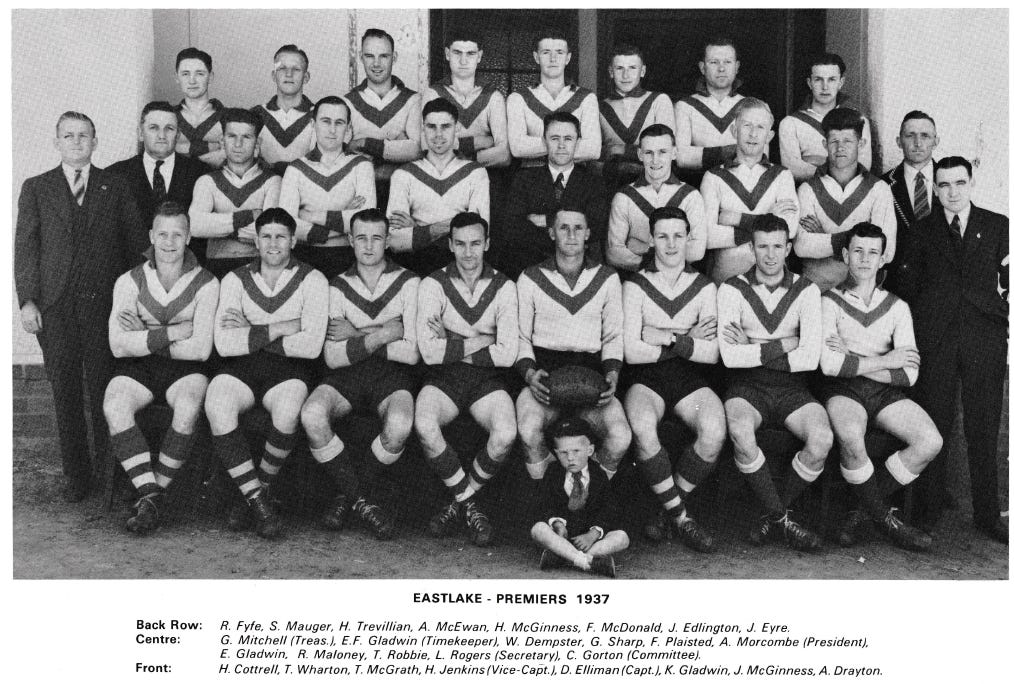
A pedestrian season was saved by some exciting finals matches and Canberra’s creditable performance against the visiting Victorian Amateur Football Association seconds. In an evenly matched senior competition where injuries and absences had a big impact on team success, Eastlake, after a slow start, steadily improved to win its fifth premiership since the club was established in 1926. Manuka’s Western Australian recruit, Phil Barrett, won the Mulrooney Medal.1 Cyril Green, CANFL president in 1935, was awarded life membership of the league. Ainslie won the juniors.
The season
Previously the Blues, Queanbeyan became the Tigers, adopting the black and yellow guernsey of the Richmond football club.2
While Goulburn held an annual general meeting in February, there was no realistic prospect of it fielding a side in 1937. Several key players were playing with Queanbeyan and Canberra clubs were divided about the Maroons returning given the transport challenges and their mid-season withdrawal in 1936.3
There were the usual gripes about the allocation and state of football grounds in Canberra. Eastlake returned to Kingston Oval, now with a small grassed infield around a turf cricket pitch but few other improvements. The outfield was poor and the dressing sheds still lacked electric light - the CANFL complained that ‘the wooden shutters being closed, as they have to be in these cold evenings, the interior is in almost total darkness’. Later in the season, there were complaints about the ‘filthy state of the opening between the sheds… where the umpires have to change. Apparently a swagman has been camping there’.4
Matches starting late (and finishing in semi-darkness) remained a problem. Typically, clubs asked players to be at the oval at 2.20pm, or even 2.30pm, for a 2.45pm start.5
The League significantly increased umpires’ remuneration ‘in the hope of attracting a wider field’. It also obtained a supply of rule books which it made available for free to umpires, players and supporters. The League’s finances were ‘satisfactory’ particularly compared to a few seasons before when it was around 100 pounds in debt.6
In February, the Canberra Amateur Swimming Club ran its second annual footballers’ relay race. Each Canberra club entered a team, with the winner taking possession of the ‘FCT National Football Shield’ donated by the League. Manuka repeated its 1936 victory, this time with all teams swimming in club guernseys.7
The Canberra Times, in a report on the Eastlake-Manuka second semi-final, observed that:

Nevertheless, spectators caused problems from time to time, often crowding goal and boundary lines. In July, the field umpire was forced to ‘gently chide a couple of Manuka… supporters for, probably accidentally, shaking a post when an inexperienced Ainslie forward was trying for goal…’. If matters became heated onfield, spectators could occasionally feel the need to become involved (see below).8
Seniors
The seniors played a 15-round regular season, with each side having three byes. Clubs commenced pre-season training in early April and a few practice matches were played as the start of the season approached.9
With the Prime Minister on an extended trip to in London for the coronation of George VI and an Imperial Conference, the season was opened on Saturday, 8 May, by the British High Commissioner, Sir Geoffrey Whiskard. Lady Whiskard unfurled Ainslie’s 1936 premiership pennant. Sir Geoffrey, at his first game of Australian football, was reportedly ‘in the centre to bounce the ball’ at the start of the grand final replay between Ainslie and Acton (Ainslie won by a point).10
Acton’s season looked promising, recruiting former Carlton player, Joe Russell, as coach, reported to be a ‘disciplinarian with ideas somewhat novel to Canberra’. The Magpies also retained most of their 1936 side which had finished runner-up. They started well, winning two of their first three games, the only loss being to Ainslie in the opening round where they led for most of the game. But Acton won only one more game for the season, finishing in last place, their last game a 143 point ‘massacre’ at the hands of Eastlake. Injuries to key players played a significant role - the Magpies were forced to call on St Johns’ juniors for their disastrous last game and played 34 players across the season. There were also questions about the new coach’s adoption of ‘boots-and-all tactics to the elimination of the fast low passing and long kicking’ of 1936.11

While Queanbeyan retained most of its 1936 side, supplemented with more ex-Goulburnites, it was hampered by the unavailability of key players at various stages of the season. The Tigers played Ainslie with only 17 men in May. Their captain-coach, Floyd Primmer, remained suspended until the third round for an incident in late 1936. In last place by early June, players started returning and - in an even competition - Queanbeyan was briefly in equal first place only a few weeks later, their handball-heavy playing style (for the times) yielding positive results, and despite losing two more players to suspension. Absences became a problem again in July though, worsened when Primmer seriously injured his shoulder in Canberra’s match against the VAFA in early August. The Tigers drifted out to fourth spot by the end of the regular season.12
Ainslie retained most of their champion 1936 side but two of the departures were star forwards Roe and Collins. The Tricolours won their first three games to take their winning streak to twenty before succumbing to Eastlake by 44 points at Kingston in late May. A run of absences and injuries saw them struggle through the middle part of the season. While their form improved as players returned, narrow losses to Eastlake and Manuka in August saw them finish third.13
Like most clubs, Manuka retained the bulk of its key players from 1936. It also recruited Phil Barrett, a Forestry School student from Western Australia who would win the Mulrooney Medal in his first season. After some early season injuries, the team ‘settled down to serious training’ in June and a month later was top of the table, ‘its machine working smoothly and its best men available’. The Black and Reds stayed there for the rest of the regular season despite some injuries.14

Eastlake were christened the ‘Gorillas’ by the Canberra Times after the new Fitzroy ‘soubriquet’ because they were perceived to play a similar ‘rough but not necessarily unfair’ style of football. They started slowly, young players from the seconds replacing departing veterans and the club perhaps not having learnt the lessons of 1936 when it trained poorly. By the end of June, the Red and Whites were in last place with only one win and looking anything but premiership contenders. Their second win was against an injury-weakened Ainslie, the first of six successive wins that propelled them into second place at the end of the regular season. In part this reflected other clubs faltering, but Eastlake also gradually improved over the second half of the season as experienced players returned and youngsters settled in.15
The finals
Ainslie met Queanbeyan in the first semi-final at Manuka. With the Tricolours 30 points up as the third quarter started, tempers frayed, resulting in a violent onfield incident. Police intervention was needed at three-quarter time and immediately after the final whistle to maintain public order.

Two Queanbeyan players were suspended - Jack Kennedy for eight weeks for striking Ainslie’s Sam Dee, and J Walters for four weeks for using intimidating language to a boundary umpire.16
Eastlake met Manuka at Northbourne in the second semi-final. ‘Encouraged by yells of support from the trek of barrackers who moved each quarter to be at Eastlake’s goal’, they were up by 26 points at three-quarter time. Phil Barrett then led a last-quarter Manuka fightback, the Red and Blacks kicking four goals to one, to be within five points with the ball out of bounds near Manuka’s goal - when the final siren blew. The large crowd included the Leader of the Opposition, John Curtin, and ‘parliamentarians from every State in the Commonwealth’.17
The preliminary final between Manuka and Ainslie followed a similar script, with the Red and Blacks ten points down at three-quarter time and looking beaten. Manuka rallied though to kick four goals in the last to win by five points. Eastlake played a curtain-raiser against North Shore, who were visiting from Sydney.18

The grand final pitted Eastlake - playing ‘vigorous, headlong football… allied to a crafty policy of hampering the opposition at its strongest points’ - against Manuka - ‘more South Australian in style relying on pace and spectacular combination in open play’. The match, played at Manuka before 1500 spectators (and two dogs), saw the scoreboard lead alternate as each team took advantage of the ‘variable wind’ blowing to the theatre end. Manuka struggled to score in the third quarter though, with its best forward, Barrett, ‘closely watched by three Eastlake backmen, who closed in on him whenever the ball came near’. Only nine points up at three-quarter time and starting to tire, the Red and Blacks were overrun in the last quarter by an Eastlake side intent on ‘opening up the game’ - they kicked 32 points to 1. Les Robbie and Johnny Eyre were best for Eastlake, while Manuka’s best was Jack Dorman. The umpire, Bert Miller, appears to have been suitably unobtrusive.19
Intermediates
The League remained keen to develop a competition for players too old for juniors and too young for the seniors but was hampered by a lack of numbers. Beginning with a match in early May between two combined sides (Ainslie-Queanbeyan against Manuka-Eastlake-Acton), by June the competition had evolved into regular matches between Queanbeyan - the only club that could reliably field a team - and a team organised by the Canberra senior club with the bye. The latter comprised recent graduates from the ‘bye’ club’s juniors, younger senior team members and, if needed, young players from other clubs. The winner of each game took possession of the Peter Dawson Cup (donated by the whisky company of that name to Queanbeyan some years earlier). While Canberra sides won the early games, Queanbeyan won the last two to be in possession of the Cup at the end of the season.20
Juniors
Five teams competed in the juniors in 1937. St John’s (the ‘midgets’) and St Christopher’s (the ‘molecules’) were much smaller than the other three teams, with the Canberra Times noting that ‘most of them appear to have four or five years to go before age would compel them to seek an over-sixteen grade’. They played each other at Manuka in June when even their best players were:
St John’s formally came under Acton’s ‘patronage’, converting from green to the black and white guernseys of the Magpies. Senior Acton players turned up ‘en masse’ at the youngsters’ opening game against Ainslie. Manuka sponsored St Christopher’s. Queanbeyan was not quite as strong (or big) as Ainslie or Eastlake and finished third, defeating St Christopher’s in the first semi-final, a result that was reversed by the League because of ‘irregularities’ in the Tigers’ team. Inevitably Ainslie and Eastlake met in the grand final at Manuka (played as the curtain-raiser to the senior grand final), with the Tricolours winning by 10 points to retake the Kaufman Cup.21
Canberra was to play in the national schoolboys’ carnival in Hobart commencing in late August. Trial matches were played, money raised (including by a dance and cards night at Brassey House), a side was selected and blazers presented. Then the trip was suddenly cancelled - Tasmania, like other states, was concerned that teams passing though Melbourne on their way to Hobart would spread the ‘infantile paralysis’ (polio) epidemic afflicting the Victorian city.22
Victorian Amateurs
Early ideas of a return match against Queensland in Brisbane came to nothing. In July though, a match with the Victorian Amateur Football Association seconds team was arranged for 7 August at Manuka Oval, the first visit to the national capital by a Victorian side. Upon their arrival on the Thursday before the game, the southerners were welcomed by the Federal Attorney-General, Robert Menzies QC, at Parliament House. ‘A big crowd of onlookers’ watched the Victorians train at Manuka for an hour the next morning, including a somewhat smitten Canberra Times reporter:
Canberra’s side, captained by Queanbeyan’s Floyd Primmer, contained only 11 players from the 1936 side. The Victorians were taller and slightly heavier on average. The match, watched by what the Canberra Times said was a ‘record football attendance’, saw the locals surprise the Victorians in the first half, only 24 points down at the main break despite having the same number of scoring shots. They briefly hit the lead in the third quarter following two goals by Phil Barrett but inaccuracy in front of goals - and the Victorians’ accuracy - continued to undermine their efforts, the match finishing with the visitors 41 points ahead from one more scoring shot.
Following the game, the Victorian captain, C Loughrey, conceded that ‘they had been led to believe that they were in for an easy victory but they had had to fight for their lives…’. While the Victorians had ‘won in the air’, the locals had ‘won in the ground play and had checked Victoria’s brilliant men, leaving the steady players to save the day’. The Victorian manager congratulated Bert Miller on ‘an excellent umpiring performance’ although they found his interpretation of holding-the-ball ‘more lenient than that to which they were accustomed’.23

Votes for the Mulrooney were awarded as follows: field umpires selected, in order, three players from each match whom, in their opinion, were the best and fairest players for the day. These selections were handed to the League in sealed envelopes, and at the conclusion of the regular season, these votes were counted and the player receiving the most votes awarded the J L Mulrooney Medal: League Meeting, The Canberra Times, Fri 27 Aug 1937, p.6. Trove - National Library of Australia, accessed 8 August 2025.
National Football, The Canberra Times, 19 Apr 1937, p.2; Australian Rules, Queanbeyan Age, 7 May 1937, p.1; Manuka Methodical, The Canberra Times, 10 May 1937, p.3. Trove - National Library of Australia, accessed 8 August 2025.
Goulburn closed its bank account in December, donating its remaining one shilling to the local hospital: Australian Rules, Goulburn Evening Penny Post, 17 Feb 1937, p.7; Australian Rules Football Club, Goulburn Evening Penny Post, 19 Feb 1937, p.2; National Football, The Canberra Times, 5 Apr 1937, p.2; Bequests To Hospital, Goulburn Evening Penny Post, 15 Dec 1937, p.4. Trove - National Library of Australia, accessed 8 August 2025.
Ainslie’s 19th Successive Win, The Canberra Times, 17 May 1937, p.3. Trove - National Library of Australia, accessed 8 August 2025. Letter from CANFL to the Department of the Interior, 25 June 1937; Letter from L A Farrell to the CANFL, 2 August 1937: NAA, A659, 1944/1/3425.
The League had, for many years, argued that Australian football, as the leading code in the Federal Capital Territory, should have more access to the major grounds - Manuka and Northbourne. The Department of the Interior, presumably to be seen to be even-handed, gave broadly equal access to these grounds to Australian football and rugby league: National Football, The Canberra Times, 13 Mar 1937, p.4; Ainslie's 19th Successive Win, The Canberra Times, 17 May 1937, p.3; National Football, The Canberra Times, 22 May 1937, p.3; Ainslie Records Twentieth Success, The Canberra Times, 24 May 1937, p.3; National Football, The Canberra Times, 8 Jun 1937, p.4; National Football, The Canberra Times, 26 Jun 1937, p.5; National Football, The Canberra Times, 6 Jul 1937, p.4; National Football, The Canberra Times, 17 Jul 1937, p.4. Trove - National Library of Australia, accessed 8 August 2025.
The main senior field umpires for 1937 were Bert Miller, Roy Wicker (an ex-Eastlake player) and Frank Bishop. The League still operated an Accident Fund to assist injured players: National Football, The Canberra Times, 13 Mar 1937, p.4; National Football, The Canberra Times, 19 Apr 1937, p.2. Trove - National Library of Australia, accessed 8 August 2025.
The Swimming Club also ran a 66 yard handicap for footballers for a ‘special trophy’ it donated (Lon Hellier from Manuka won in 1937): Swimming, The Canberra Times, 26 Feb 1936, p.3; Keen Racing, The Canberra Times, 27 Feb 1936, p.5; National Football, The Canberra Times, 10 Feb 1937, p.3; National Football, The Canberra Times, 17 Feb 1937, p.3; Swimming, The Canberra Times, 18 Feb 1937, p.2. Trove - National Library of Australia, accessed 8 August 2025.
National Football, The Canberra Times, 6 Jul 1937, p.4; National Football, The Canberra Times, 13 Jul 1937, p.4. Trove - National Library of Australia, accessed 8 August 2025.
National Football, The Canberra Times, 5 Apr 1937, p.2; National Football, The Canberra Times, 16 Apr 1937, p.3; National Football, The Canberra Times, 19 Apr 1937, p.2; National Football, The Canberra Times, 22 Apr 1937, p.2; National Football, The Canberra Times, 26 Apr 1937, p.3; National Football, The Canberra Times, 27 Apr 1937, p.4; National Football, The Canberra Times, 1 May 1937, p.4. Trove - National Library of Australia, accessed 8 August 2025.
National Football Season Opens, The Canberra Times, 10 May 1937, p.3; Coronation, The Canberra Times, Tue 23 Mar 1937, p.1. Trove - National Library of Australia, accessed 8 August 2025.
Jim Toohey captained Acton in 1937. The side on trained on Monday and Wednesday nights at Manuka Oval: National Football, The Canberra Times, 16 Apr 1937, p.3; National Football, The Canberra Times, 26 Apr 1937, p.3; National Football, The Canberra Times, 8 May 1937, p.3; National Football, The Canberra Times, 11 May 1937, p.4; National Football, The Canberra Times, 1 Jun 1937, p.4; Acton's Place In Finals Endangered, The Canberra Times, 12 Jul 1937, p.3; National Football, The Canberra Times, 13 Jul 1937, p.4; Ainslie Beats Acton, The Canberra Times, 26 Jul 1937, p.3; Eastlake Overwhelms Acton, The Canberra Times, 23 Aug 1937, p.3; National Football, The Canberra Times, 23 February 1938, p.3. Trove - National Library of Australia, accessed 8 August 2025.
National Football, The Canberra Times, 8 May 1937, p.3; National Football, The Canberra Times, 18 May 1937, p.4; National Football, The Canberra Times, 29 May 1937, p.3; Queanbeyan Bids For Leadership, The Canberra Times, 21 Jun 1937, p.3; Australian Rules Football, Queanbeyan Age, 27 Jul 1937, p.3; Manuka's Runaway Victory, The Canberra Times, 2 Aug 1937, p.3; Australian Rules Football, Queanbeyan Age, Tue 3 Aug 1937, p.4; Australian Rules Football, Queanbeyan Age, Fri 13 Aug 1937, p.3; Australian Rules Football, Queanbeyan Age, Fri 20 Aug 1937, p.3. Trove - National Library of Australia, accessed 8 August 2025.
Jim Keogh coached Ainslie and Lionel James was captain: National Football, The Canberra Times, 10 Mar 1937, p.3; National Football, The Canberra Times, 11 May 1937, p.4; Ainslie Records Twentieth Success, The Canberra Times, 24 May 1937, p.3; Eastlake's Victory, The Canberra Times, 31 May 1937, p.3; National Football, The Canberra Times, 22 Jun 1937, p.4; National Football, The Canberra Times, 3 Jul 1937, p.5; Eastlake Easily, The Canberra Times, 5 Jul 1937, p.3; National Football, The Canberra Times, 17 Jul 1937, p.4; Manuka Takes Football Leadership, The Canberra Times, 2 Aug 1937, p.3; Manuka Downs Last Year's Premiers, The Canberra Times, Mon 23 Aug 1937, p.3; National Football, The Canberra Times, Sat 28 Aug 1937, p.5. Trove - National Library of Australia, accessed 8 August 2025.
Manuka’s coach was Leo Sullivan and Lou Hellier was captain: National Football, The Canberra Times, 8 May 1937, p.3; Club Notes, The Canberra Times, 15 May 1937, p.3; National Football, The Canberra Times, 29 May 1937, p.3; National Football, The Canberra Times, 5 Jun 1937, p.4; National Football, The Canberra Times, 6 Jul 1937, p.4; National Football, The Canberra Times, 20 Jul 1937, p.4; National Football, The Canberra Times, Mon 16 Aug 1937, p.3. Trove - National Library of Australia, accessed 8 August 2025.
Bill McKinstry, Eastlake’s star defender, who missed the 1936 season with a knee injury, played a practice match in March but apparently no further games: National Football, The Canberra Times, 27 Apr 1937, p.4; National Football, The Canberra Times, 29 May 1937, p.3; National Football, The Canberra Times, 1 Jun 1937, p.4; National Football, The Canberra Times, 29 Jun 1937, p.4; Eastlake Easily, The Canberra Times, 5 Jul 1937, p.3; National Football, The Canberra Times, 6 Jul 1937, p.4; National Football, The Canberra Times, 27 Jul 1937, p.4. Trove - National Library of Australia, accessed 8 August 2025.
Disqualified, The Canberra Times, Mon 6 Sep 1937, p.2. Trove - National Library of Australia, accessed 8 August 2025.
Eastlake Staves Off Manuka, The Canberra Times, Mon 6 Sep 1937, p.3; National Football, The Canberra Times, Tue 7 Sep 1937, p.4. Trove - National Library of Australia, accessed 8 August 2025.
Manuka Wins Football Final, The Canberra Times, Mon 13 Sep 1937, p.3; National Football, The Canberra Times, Tue 14 Sep 1937, p.3; North Shore Club, The Canberra Times, Mon 13 Sep 1937, p.3; National Football, The Canberra Times, Tue 14 Sep 1937, p.3; National Football, The Canberra Times, Thu 16 Sep 1937, p.3. Trove - National Library of Australia, accessed 8 August 2025.
National Football, The Canberra Times, 17 Sep 1937, p.3; Eastlake Wins Fifth Premiership, The Canberra Times, Mon 20 Sep 1937, p.3; National Football, The Canberra Times, Tue 21 Sep 1937, p.4. Trove - National Library of Australia, accessed 8 August 2025.
National Football, The Canberra Times, 13 Apr 1937, p.2; National Football, The Canberra Times, 19 Apr 1937, p.2; National Football, The Canberra Times, 23 Apr 1937, p.2; National Football, The Canberra Times, 26 Apr 1937, p.3; National Football, The Canberra Times, 28 Apr 1937, p.3; National Football, The Canberra Times, 30 Apr 1937, p.2; National Football, The Canberra Times, 3 May 1937, p.4; National Football, The Canberra Times, 7 May 1937, p.4; National Football, The Canberra Times, 21 May 1937, p.6; National Football, The Canberra Times, 11 Jun 1937, p.6; Queanbeyan Wins At Kingston, The Canberra Times, 14 Jun 1937, p.3; Club Notes, The Canberra Times, 19 Jun 1937, p.4; National Football, The Canberra Times, 25 Jun 1937, p.3; Manuka Leading On Percentages, The Canberra Times, 28 Jun 1937, p.3; National Football, The Canberra Times, 2 Jul 1937, p.2; National Football, The Canberra Times, 17 Jul 1937, p.4; Seconds, The Canberra Times, Mon 26 Jul 1937, p.3; League Meeting, The Canberra Times, Fri 27 Aug 1937, p.6. Trove - National Library of Australia, accessed 8 August 2025.
St Christopher’s initially disbanded but reformed in early June: National Football, The Canberra Times, 7 May 1937, p.4; Juniors, The Canberra Times, 17 May 1937, p.3; National Football, The Canberra Times, 21 May 1937, p.6; National Football, The Canberra Times, 25 May 1937, p.4; Manuka Again Convincing, The Canberra Times, 19 Jul 1937, p.3; National Football, The Canberra Times, 20 Jul 1937, p.4; National Football, The Canberra Times, Tue 7 Sep 1937, p.4; National Football, The Canberra Times, Fri 3 Sep 1937, p.6; Junior Grand-Final, The Canberra Times, Mon 20 Sep 1937, p.3; National Football, The Canberra Times, 17 September 1937, p.3. Trove - National Library of Australia, accessed 8 August 2025.
Schools Carnival, The Canberra Times, 20 Jul 1937, p.4; Telopea Park, The Canberra Times, 22 Jul 1937, p.2; Telopea Park, Canberra Times, 29 July 1937, p.2; National Football, The Canberra Times, 30 Jul 1937, p.3; Football Carnival, The Canberra Times, Mon 9 Aug 1937, p.3; Infantile Paralysis, The Canberra Times, 19 August 1937, p.1. Trove - National Library of Australia, accessed 8 August 2025.
The VAFA firsts playied South Australia in Melbourne on the same day. The VAFA comprised four ‘sections’ of ten teams. Canberra’s selectors were Jim Keogh, Jim Toohey and Pat Moroney. The eleven Canberra players who had played in 1936 were Elliman, Robbie, Ware, Dee, James, Primmer, Hellier, Brinkman, Cook, McCouat, and McNamara: National Football, The Canberra Times, 6 Mar 1937, p.2; National Football, The Canberra Times, 13 Apr 1937, p.2; National Football, The Canberra Times, 16 Jul 1937, p.2; Interstate Amateurs At St. Kilda, Sporting Globe, Wed 4 Aug 1937, p.3; Collegians Defeat University, The Argus, 10 May 1937, p.15; National Football, The Canberra Times, Thu 5 Aug 1937, p.4; Canberra Team, The Canberra Times, 2 Aug 1937, p.3; Canberra Makes The Grade, The Canberra Times, Mon 9 Aug 1937, p.3. Trove - National Library of Australia, accessed 8 August 2025.